Did You Know, Your Brain Has a Switch?
Meet the RAS (reticular activating system) and the 3 things it does in your daily lives!
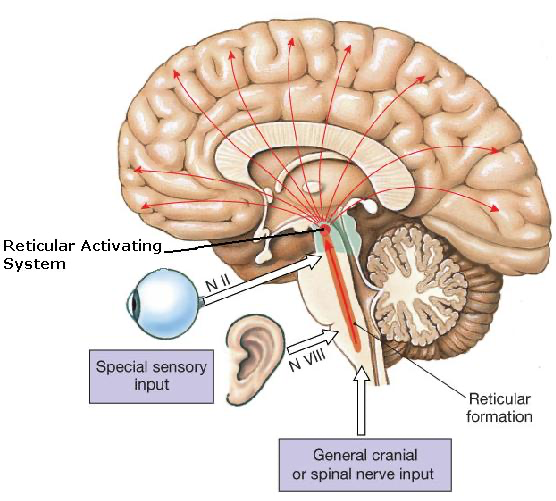
Image credits: https://rcweb.dartmouth.edu/CANlab/brainstemwiki/lib/exe/fetch.php/reticularactivatingsystem1b62e.jpeg_%3B?w=600&tok=fcd467
Most people probably have never heard of the RAS ever before. However, it is one of the most important parts of your daily life. It makes me frustrated that many blog posts describe the RAS as a “filter for what you need to focus on” when that is not the executive of the RAS system. It can do so much more.
Here are 2 facts about the RAS that you probably never heard of:
- The RAS is like a building’s power supply; it doesn’t necessarily decide that you filter in and what you filter out. In 1949, a study conducted by Moruzzi and Magoun showed that by stimulating the brainstem in sleeping cats, made their brainwave patterns fill from sleep to wide awake. So just by activating the small brain stem, compared to the rest of the brain, was able to determine whether the entire brain was asleep or awake. It also isn’t simply one chemical in our brains that gets effected when you are flipping patterns in the brainstem; different chemicals in the brain can either be tuned down or tuned up separately regardless of different chemicals. For example allergy medicine can make you feel drowsy because it tunes down the chemical called histamine, but caffeine doesn’t touch that chemical at all. It touches the chemical called adenosine which is also another chemical in the RAS system. This is why certain foods, drinks, and medicine can make us feel weird and queasy and eating multiple kids of different levelers for chemicals in the RAS can lead to bad outcomes of drowsiness and droopiness.
- The RAS is also in control of your alertness to your surroundings. In the RAS your brain has a cluster of neurons called the locus coeruleus, which is widely known as “blue spot”, that is responsible for controlling the chemical for alertness (norepinephrine). If you crank norepinephrine up too much, you tend to feel scattered and wired. However, if you crank it low, you feel foggy and un-alert. In a study done in Nature Communications (2025), they measured how well different brain regions communicated with each other on different alertness levels. Communication was active in the sweet spot of alertness but dropped whenever there was not enough norepinephrine or too much norepinephrine. They measured the people’s levels of alertness by measuring the pupil size (more alertness, the bigger the pupil). If you have ever tried to start a long and tedious task you may have noticed it is hard when you are trying to start it with a foggy, heavy mind as well as having an overstimulated and scattered brain. It is important for you to find the correct balance.
So the next time you are having a hard day, try to go outside to get sunlight to stay more alert, or you can try to have a more balanced and structured caffeine intake routine so it doesn’t mess up your RAS levels (since it is hard to quit on coffee and tea, right :) ). You can also use a simple prompt like “what are some activities and things I can do to balance my chemicals in my RAS”. Doing all of this can help reduce that fogginess or that feeling of your brain being scattered.
Notebook keeper signing off!
Sign up for the newsletter for more fun neuroscience and life related articles!